
You’re Directing Six AI Agents. Are You a Manager Now? Redefining Job Architecture for AI-Enabled Work.
AI is changing the scope, complexity, and accountability of work. What happens when the job—and the architecture around it—no longer reflects the work people are actually doing?
Most organizations are integrating AI into jobs that were designed before AI existed. Think about that for a moment.
We are asking people to use AI to automate work, expand their capabilities, make faster decisions, manage greater scope, and produce outcomes that may once have required several people—while the jobs themselves often remain largely unchanged.
Same titles. Same levels. Same career paths. Often, the same job descriptions with a few new AI responsibilities added.
But when the scope, complexity, and accountability of the work change without organizations intentionally redesigning the jobs around that work, a gap begins to emerge between the work people are actually doing and the roles that exist on paper.
That’s when AI adoption becomes a job design problem.
In our recent article, AI Is Changing More Than Jobs. It's Challenging What Organizations Reward, we explored how AI is challenging compensation models built around the job as the primary unit of value. As individuals use AI to expand their capabilities, scope, and impact, the job alone may tell us less about the value someone contributes. This raises an important question:
If the work has fundamentally changed, how do we determine whether the job itself has changed, too?
Adding AI to the Job Description Isn't Job Redesign
When organizations focus on changing only the job description, they risk solving the wrong problem. A new technology arrives. Work changes. We add several bullets to the job description:
- Leverages AI tools to increase productivity.
- Uses generative AI to support analysis.
- Identifies opportunities to automate processes.
While the job description has been updated with new AI bullets, the job itself has not been reconsidered.
Has AI fundamentally changed the job’s value, scope, or complexity? That's the more important question.
If AI enables one person to own work that previously required several roles, make decisions that once sat elsewhere, or take accountability for broader outcomes, simply adding AI responsibilities to the job description misses the bigger shift.
PwC describes an emerging phenomenon around this: role convergence. As AI lowers execution barriers, employees can operate across areas that previously required more specialized roles. Work that once moved between multiple people or functions is increasingly being owned end-to-end by one person. (PwC)
That’s more than adding an AI skill to the job. The scope and complexity of the job itself have changed.
How Do You Level a Job When AI Changes the Scope?
Traditional dimensions such as scope, expertise, and people leadership still matter when determining the level of a job. But as AI changes the work, the way organizations evaluate those dimensions may also need to change.
Consider two managers. One leads a team of three people doing relatively established work with clear processes and decision boundaries. Another has no direct reports but directs a portfolio of AI agents performing work that previously required six individual contributors. That person is accountable for the quality of the agents’ output, the decisions they inform, and the business outcomes they help produce.
So which job has greater scope? Which should be leveled higher? And, as we explored in our recent blog, should one be paid more?
The answer can't be determined by years of experience or headcount alone. We also need to consider the complexity of the work being orchestrated, the decisions each role owns, the breadth of accountability, and the outcomes each is responsible for driving.
Harvard Business Review recently profiled Zach Stauber, a support agent manager at Salesforce, who manages a fleet of generative AI agents working across support, sales, and marketing. Rather than personally executing the work those agents perform, Stauber spends his time monitoring their performance, evaluating results, identifying where they are struggling, and helping improve how they operate. HBR likens parts of the role to what a traditional manager might do with a human team. (Harvard Business Review)
Stauber’s role illustrates how AI can shift the nature and scope of work from primarily doing to directing, evaluating, integrating, and deciding—capabilities associated with broader scope and higher-level work. Roles like his challenge organizations to distinguish between managing people and managing increasingly complex work.
Building Job Architecture That Can Evolve With the Work
Traditional job architecture gives organizations a common language for work. It organizes jobs into functions and families, differentiates levels, and creates the foundation for compensation, hiring, development, workforce planning, and mobility.
As AI changes the scope and complexity of jobs, organizations may also need to rethink how that work is evaluated within the architecture when familiar measures no longer tell the full story.
Job architecture can account for these changes, but only if organizations are willing to rethink how they define, differentiate, and evaluate the work itself.
Here’s how we’re helping our clients build job architecture that can keep pace as AI continues to change the work within it:
1. Start with the work, not just the existing job description.
Job descriptions are an important starting point, but they need to be tested against how work is actually getting done and how AI is changing it. What work is disappearing, expanding, moving across roles, or being consolidated? Where are people taking on greater decision-making or accountability?
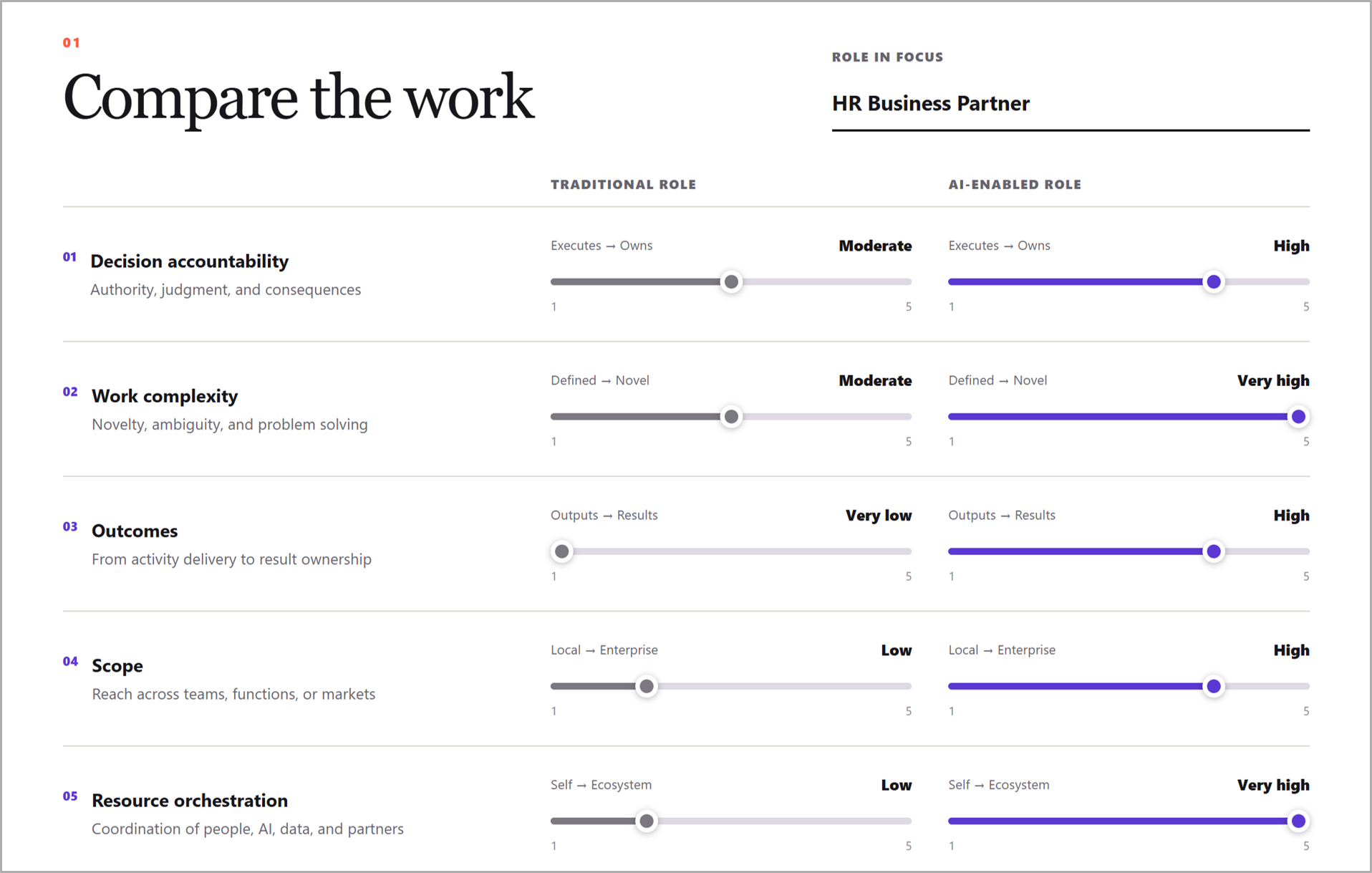
At Acera, we've developed an AI Work Simulator for our clients to help make those changes visible. The simulator is tailored to the organization and the specific role, allowing us to explore the dimensions of work most relevant to how that job may change. For illustration, the example below focuses on several of the dimensions discussed in this article: decision accountability, work complexity, outcomes, scope, and resource orchestration.
We use this simulator to open a sharper conversation about the evolution of the role, not to manufacture a universal score. Through this lens, we can determine whether the job itself needs to change, not simply whether its job description needs to be updated.
2. Anchor jobs in outcomes, not tasks.
AI will continue to change how work gets done, so focus the job on what is less likely to change with the technology: its purpose and the outcomes it owns. This creates a more durable definition of the job even as the tasks used to accomplish it evolve.
3. Define levels around scope and complexity.
Revisit what differentiates one level from another. Consider not only traditional factors such as team size, experience, and direct reports, but also the complexity of work being orchestrated, the breadth of decision-making and accountability, and the outcomes the job owns.
4. Focus on capabilities.
Identify the capabilities that will continue to differentiate successful performance across jobs and levels—not simply proficiency with today's AI tools. Judgment, problem-solving, integration, influence, collaboration, relationship management, and the ability to direct and evaluate AI-enabled work are likely to endure even as specific technologies change.
5. Design for change from the beginning.
Don't treat job architecture as a project that ends when the framework launches. Establish clear governance for when jobs should be reviewed, how changes in work trigger updates, and who determines whether those changes affect the job, its level, or its pay.
At Acera, we believe the answer isn't to abandon the fundamentals of job descriptions and job architecture. In the face of constant change within the work itself, these are even more critical structures to help guide our decisions about how jobs are defined, differentiated, and leveled.
The goal isn't to predict exactly how AI will change every job. That would be a never-ending chase. The opportunity is to build enough durability and flexibility into both the jobs and the architecture so they can evolve as the work changes.
That means redefining jobs around outcomes, capabilities, and accountability while ensuring the architecture can recognize and absorb changes in scope, complexity, and contribution in a consistent and defensible way. Both matter. Addressing one without the other leaves organizations anchored to old ways of defining work.
Acera Partners builds integrated talent and compensation strategies that foster growth.


